The Union Bridge Fire Company hosted a "Tanker Operations Drill" at 0800 hours on Sunday, March 25, to provide an opportunity for our neighboring departments to practice rural water supply delivery. Various types of fire apparatus from New Windsor, Taneytown, Pleasant Valley and Libertytown (Frederick County) met at the Union Bridge Fire Station for a short briefing. The premise of the drill was to provide personnel with a better understanding of "Fill Site" and "Dump Site" operations since these types of operations are needed only a few times a year.
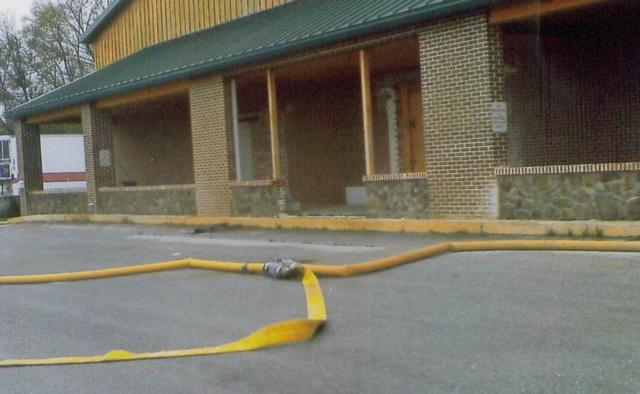
Engine 101 (New Windsor) laid out supply line with a 4" Siamese in front of the new "Trouts Grocery Store" while Engine-Tanker 82 established the "Dump Site" about 200' away. While the crews began to set-up the 'Dump Tanks', Tanker 17 (Libertytown) arrived and hooked into the siamese to provide water to Engine 101. The initial 'fire flow' was 500 GPM through a blitzfire portable attack gun.
As operations were underway at the "fire ground", Engine 52 (Taneytown) began set-up of the "Fill Site" that was located a 1/2 mile away at "Stambaugh's Hardware" on Main Street. Using four 10' hard tubes and a floating strainer, they were able to establish a draft and prepared a 5-way manifold for filling the tankers. Taneytown personnel also had an opportunity to try a new appliance they purchased called a "Turbo-draft". This appliance can be used when fire apparatus is unable to get close to a draft site. Water from the Engine is pumped into the appliance and a venturi effect "pushes" water into a supply line, back to the Engine.
Once additional Tankers arrived at the "Dump Site", two additional 'Dump Tanks' were set-up and "cross-over" tubes with jet siphons were placed in-service to move water from each tank to the 'draft tank'. As the 'Dump Tanks' were filled, Tanker 17 disconnected from the siamese and joined in the rotation from 'Dump Site' to 'Fill Site'. At one point in the operation, the 'fire flow' reached 900 GPM with just 3 Tankers (2 - 3000 Gallon and 1 - 1500 Gallon), but we were unable to maintain this flow for very long. A 'fire flow' greater than 500 GPM could be maintained with additional Tankers.
Crews rotated between the "Dump Site" and the "Fill Site" during the drill so that everyone could see the total operation. The drill ended at 1200 hours. E-81, RS-8 and PM-89 remained in-service during the drill.
Thanks to all personnel and companies that participated in this successful drill. We would also like to thank the owners of "Trout's Grocery" and "Stambaugh's Hardware" for giving us permission to use their properties for the drill. Future drills like this will be held to encourage a good working relationship between mutual aid companies and to help prepare personnel for this type of operation during emergency incidents.
Ta-17 in background as 'Nurse Tanker' while Ta-6 fills the #2 'Dump Tank'. E/T-82 has just begun providing water to the 'fireground'. Photo: P. Jones
Ta-17 provides water to the 'fireground' through the 4" Siamese. Photo: P. Jones
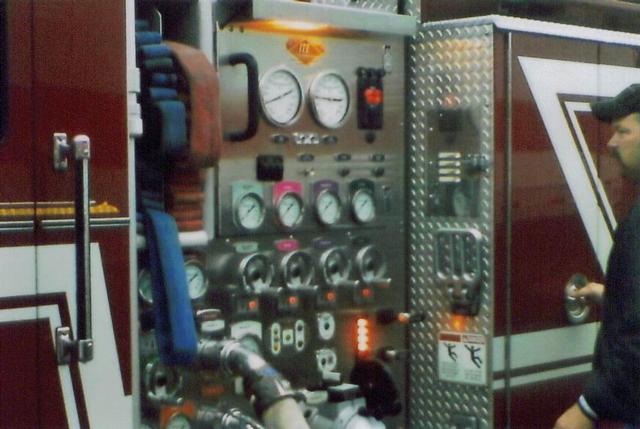
PO Dale Lowman (Co 10) operates the "Attack Engine" (E-101) on the 'fireground'. Photo: P. Jones
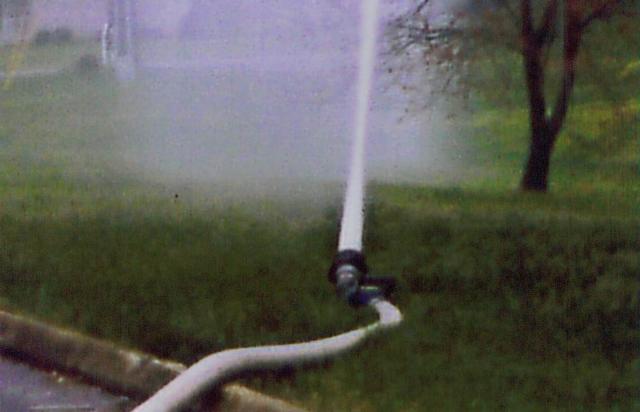
'Fire flow' during the operation ranged from 500 GPM to 900 GPM (Deck Gun on E-101) provided the additional GPM). Photo: P. Jones
E/T-54 at the "Fill Site". A 5-way Manifold is used to allow crews the ability to 'hook-up' more than one unit at a time. Only one Tanker should be filled at a time. Photo: P. Jones
E-52 is set-up as the 'Draft Engine'. Water is circulated to maintain "Prime". Photo: P. Jones
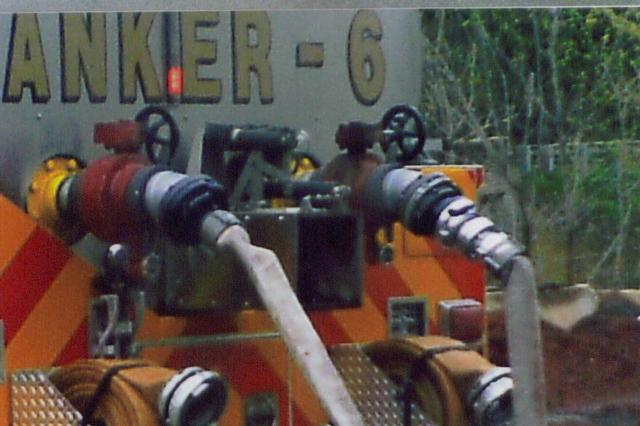
Ta-6 waits for it's turn to get filled. Typical 'hook-up' at the 'Fill Site'. Photo: P. Jones
As the operation continues, Tankers were only filling the two "outboard" tanks to reduce turbulence in the "inboard" tank that is being 'drafted' from. Photo: P. Jones
Due to the increased 'fire flow', B-105 was used to move water from the #3 "outboard" tank to the "inboard" tank. Photo: P. Jones
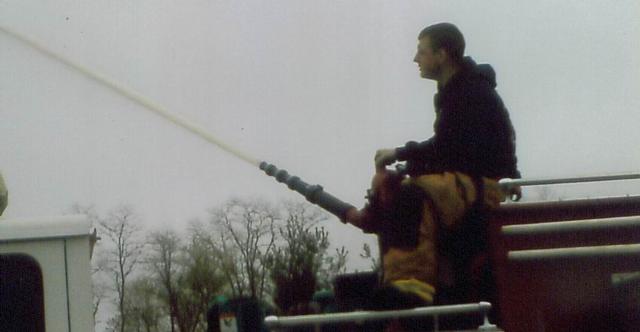
At the end of the drill, FF Phil Duerr discharges water from E/T-82. Photo: P. Jones